Thread Pitch Calculator
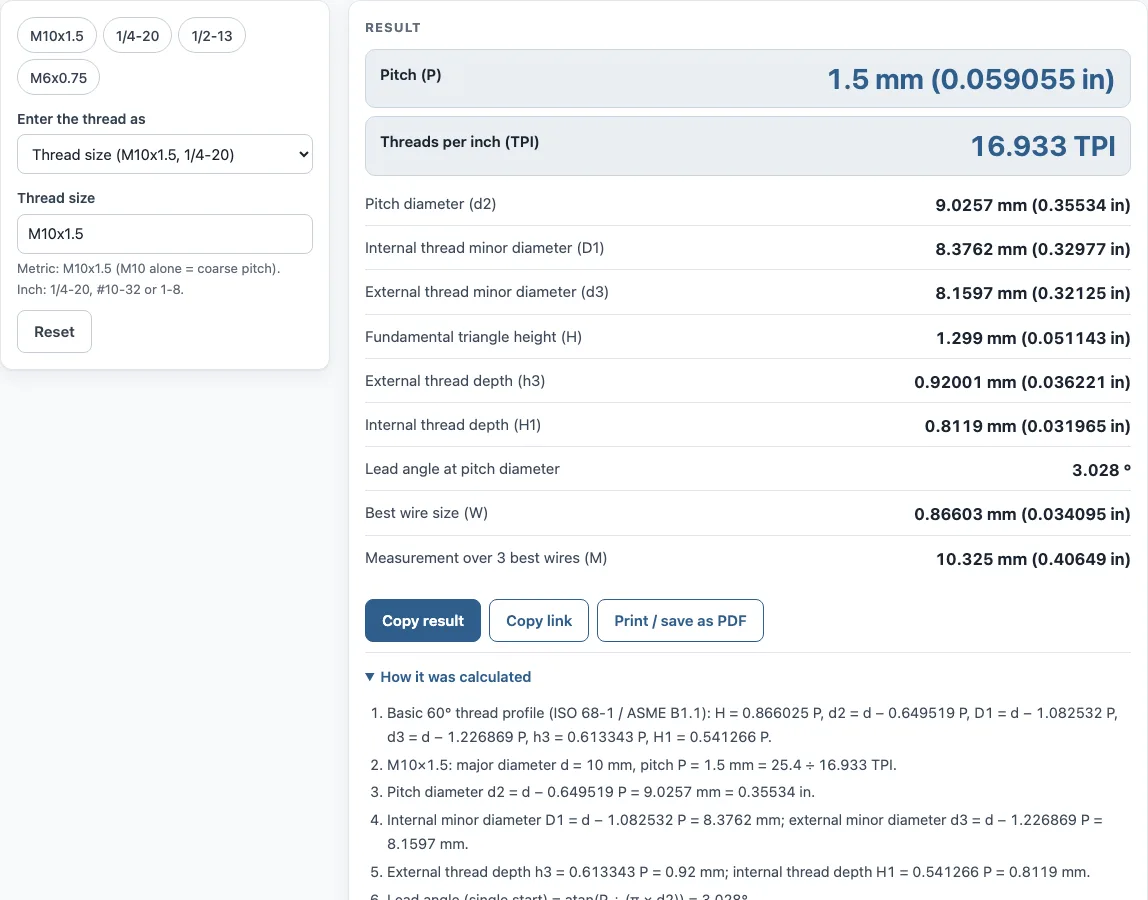
Enter a thread like M10x1.5 or 1/2-13 to get its basic pitch and minor diameters, thread depth and the measurement over three wires.
The thread pitch calculator works out the pitch, threads per inch (TPI), pitch diameter, minor diameters, thread depths, and best wire size for a screw thread. Enter a thread size such as M10x1.5 or 1/4-20, or enter a major diameter with a pitch or TPI, and the results update as you type.
This thread dimensions calculator shows every length in both mm and inches, so one page covers metric and inch threads. It also gives the depth of both external and internal threads, so you can use it as a depth of thread calculator.
It runs in your browser, is free, and needs no sign-up. Nothing is uploaded, and it works on a phone.
How to use the Thread Pitch Calculator
- Enter the thread size in the thread size box, using a format such as M10x1.5, 1/4-20, #10-32, or 1-8.
- If you only know the diameter, leave the size box empty and enter a major diameter, then either the pitch or the threads per inch.
- Check how a bare size is read. M10 alone is treated as a coarse pitch thread, so type M10x1.5 if you need a fine pitch.
- Read the results. They include pitch P and TPI, pitch diameter d2, internal minor diameter D1, external minor diameter d3, fundamental triangle height H, external thread depth h3, internal thread depth H1, the lead angle at the pitch diameter, the best wire size, and the measurement over three wires.
- Look for a warning. One appears if the size is not in the standard lists or if the pitch is more than half the major diameter.
- Open “How it was calculated” to see the formula and each step with your numbers.
Copy result copies the result lines with a link. Copy link copies the page address, which stores every input in the address (?s=…), so opening it later restores the same calculation. Print / save as PDF prints the inputs, results, calculation steps, and the date.
What is the formula for pitch diameter?
The pitch diameter (d2) is the diameter of the imaginary cylinder where the groove width and the ridge width are equal. For a basic 60° thread, d2 = d − 0.649519 P, where d is the major diameter and P is the pitch. For M10x1.5, this gives 10 − 0.649519 × 1.5 = 9.0257 mm.
How do you calculate thread depth?
Thread depth depends on whether the thread is external or internal. For an external thread, h3 = 0.613343 P. For an internal thread, H1 = 0.541266 P. Both come from the fundamental triangle height, H = 0.866025 P, which is the height of the sharp V before the crests and roots are cut flat. For M6x0.75, h3 is 0.460 mm.
How do you measure thread pitch?
Measure the distance from one crest to the next adjacent crest, along the thread axis. That distance is the pitch P in mm. For inch threads, count the threads per inch, then use P = 1 ÷ TPI. A 20 TPI thread has a pitch of 0.05 in, or 1.27 mm.
How do you convert TPI to pitch?
To get pitch in inches, divide 1 by the TPI. To get pitch in mm, divide 25.4 by the TPI. To go the other way, divide 25.4 by the pitch in mm to get TPI. For example, 12 TPI is 2.117 mm, and a 1.5 mm pitch is 16.93 TPI.
What is the best wire size for measuring threads?
The best wire size is W = 0.577350 P. This wire touches the thread flanks at the pitch line, which is where the pitch diameter is measured. The measurement over three wires is M = d2 + 3W − 0.866025 P. The calculator shows both values for your thread.
What are the minor diameters of an internal and external thread?
The internal minor diameter is D1 = d − 1.082532 P, and the external minor diameter is d3 = d − 1.226869 P. For M10x1.5, D1 is 8.376 mm and d3 is 8.160 mm. The external minor diameter is smaller because the external root is cut deeper.
Sources
- ISO metric screw thread (Wikipedia) — ISO 261 coarse and fine pitches and the ISO 68-1 basic profile
- Unified Thread Standard (Wikipedia) — UNC and UNF threads per inch (ASME B1.1)
- Screw thread (Wikipedia) — three-wire measurement, best wire 0.57735 × pitch
Worked examples
| Input | Result |
|---|---|
| M10x1.5 | P = 1.5 mm (16.93 TPI), pitch diameter 9.0257 mm |
| 1/4-20 | P = 1.27 mm (20 TPI), pitch diameter 5.5251 mm |
| 1/2-13 | P = 1.954 mm (13 TPI), pitch diameter 11.431 mm |
| M6x0.75 | P = 0.75 mm (33.87 TPI), pitch diameter 5.5129 mm |
| d = 1 in, 12 TPI | P = 2.117 mm (12 TPI), pitch diameter 24.025 mm |
Calculated by the tool above with these values.
Frequently asked questions
What does M10 alone mean in the thread size box?
It is read as a coarse pitch thread. The calculator fills in the standard coarse pitch for that size. If you need a fine pitch, type the full size, such as M10x1.25.
Why does the calculator show a warning?
A warning appears when the size is not in the standard lists or when the pitch is more than half the major diameter. Check the size and pitch you entered. Your thread may be a non-standard form, so confirm it against your drawing.
Why do my measured parts not match these numbers?
The results are basic, zero-allowance dimensions. Real parts are made to a tolerance class, such as 6g/6H or 2A/2B, which makes external threads smaller and internal threads larger than the basic values. Use the tolerance class from your drawing to find the limits.
Can I use the results on a quote or inspection report?
Yes. Results may be used in commercial work, including quotes, shop travelers, setup sheets, inspection reports, and customer documents, without attribution. Print / save as PDF gives you a copy that includes the inputs, steps, and date.
Do I need an account to save a calculation?
No. There is no sign-up. Copy link stores your inputs in the page address, so you can bookmark or send it and reopen the same calculation later.
Related tools
- Drill and tap chart: Use it to find the tap drill size for a thread before you start tapping.
- NPT tap drill chart: Use it when you are working with NPT pipe threads instead of the threads on this page.
- Drill size chart: Use it to compare number, letter, and fraction drill sizes.
- Decimal to fraction inches chart: Use it to convert the inch lengths from your results to fractions.
- Speeds and feeds calculator: Use it to set cutting speeds and feeds once you know the thread details.
- Machine screw size chart: use it to look up number-size screw diameters and their thread pitches.
- Thread milling calculator: use it to get RPM and the corrected feed for milling a thread.
- All machining calculators: Use it to browse every calculator on the site.