Thread Milling Calculator
Enter the thread, the thread mill and the cutting data to get RPM, the programmed feed for the tool centre line and the cutting time.
The Thread Milling Calculator works out the numbers a CNC program needs to cut a thread with a thread mill. Enter whether the thread is internal or external, its major diameter and pitch, the cutter diameter and flutes, and the cutting speed and feed per tooth from your tool maker. It returns the spindle RPM, the feed at the cutter edge, the corrected feed to program at the tool centre line, the radius of the helical path, the number of turns and the cutting time for one pass.
The correction matters because a machining centre applies the programmed feed at the centre of the tool, not at its edge. On an internal thread the edge travels on a larger circle than the centre, so the programmed feed must be smaller or the cutter is overloaded. On an external thread it is the other way round.
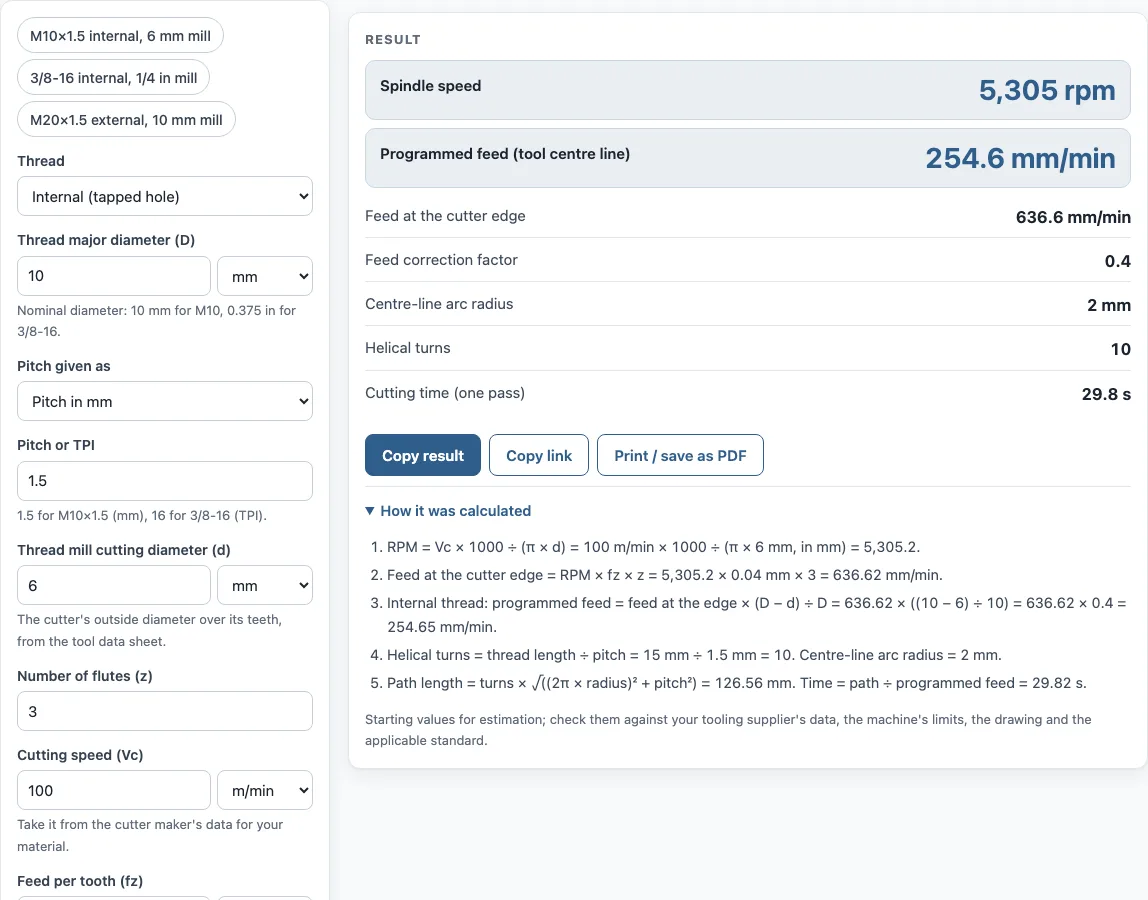
How to use the Thread Milling Calculator
- Choose Internal (tapped hole) or External (on a shaft).
- Enter the Thread major diameter and pick inches or mm. Use 10 mm for M10 or 0.375 in for 3/8-16.
- Choose how the pitch is given, Pitch in mm or Threads per inch, and type the number: 1.5 for M10×1.5, 16 for 3/8-16.
- Enter the Thread mill cutting diameter and the number of flutes from the tool data sheet.
- Enter the Cutting speed (SFM or m/min) and the Feed per tooth that the tool maker recommends for your material.
- Enter the Thread length you want to cut.
- Read the spindle speed and the Programmed feed (tool centre line). The lines below show the edge feed, the correction factor, the arc radius, the number of helical turns and the time.
The presets load an M10×1.5 internal thread, a 3/8-16 internal thread in inches and an M20×1.5 external thread. Open How it was calculated to see each step with your numbers. Copy link stores the inputs, and Print / save as PDF prints the sheet with the date. Change one input at a time, such as the cutter diameter or the feed per tooth, to see how the programmed feed and the cycle time respond. Nothing you type leaves your browser.
How do you calculate the feed rate for thread milling?
Start with the feed at the cutter edge: RPM × feed per tooth × number of flutes. This is the number a tool maker gives you as a chip load. Then correct it for the path of the tool centre. For an internal thread, programmed feed = edge feed × (D − d) ÷ D, where D is the thread major diameter and d the cutter diameter. For an external thread, programmed feed = edge feed × (D + d) ÷ D.
For the default M10×1.5 thread with a 6 mm, three-flute mill at 100 m/min and 0.04 mm per tooth, RPM is 5305, the edge feed is 637 mm/min, the factor is (10 − 6) ÷ 10 = 0.4, and the programmed feed is about 255 mm/min.
How do you calculate spindle speed for a thread mill?
Use the cutter diameter, not the thread diameter: RPM = cutting speed × 1000 ÷ (π × d) with d in mm. A 6 mm cutter at 100 m/min turns at 100 000 ÷ (π × 6) = 5305 rpm. In inches, RPM = SFM × 12 ÷ (π × d).
How many helical turns does a thread need?
One turn of the helix per pitch of thread depth. A 15 mm thread with a 1.5 mm pitch needs 10 turns. The tool also needs a lead-in arc and a lead-out arc, which this calculator does not include; add them to your program or CAM setup.
What size thread mill do I need?
For an internal thread the mill must fit in the core hole: smaller than the thread’s minor diameter. The basic minor diameter of an internal thread is the major diameter minus 1.0825 × pitch, so about 8.38 mm for M10×1.5. The calculator warns if your cutter is not smaller than that. A larger cutter makes the path radius smaller and the cycle shorter, but check that it leaves enough material in the flank.
What is a threadmill?
A threadmill (or thread mill) is a cutting tool that mills a thread by moving in a helix, instead of forming it as a tap does. One thread mill of a given pitch can cut different thread diameters, because the diameter is set by the toolpath rather than the tool.
Sources
- Newman Tools thread mill catalogue: the corrected feed AFR = NAFR × (D − d) ÷ D for internal threads, with a worked example. Checked October 2026.
- CNCzone: Thread milling feeds and speeds: the same relationship quoted from a thread mill catalogue (a forum post, so treat it as supporting only).
- Surface speed relation from Machinery’s Handbook; basic minor diameter D − 1.082532 × P from the ISO 68-1 basic thread profile.
- The external-thread factor (D + d) ÷ D follows from the same geometry: the tool centre travels on a circle of diameter D + d while the thread is cut at diameter D. Check your tool maker’s guidance for your tool.
Worked examples
| Input | Result |
|---|---|
| Internal (tapped hole), D 10 mm, cutter 6 mm | 5,305 rpm, programmed feed 254.6 mm/min |
| Internal (tapped hole), D 0.375 in, cutter 0.25 in | 4,584 rpm, programmed feed 6.875 in/min |
| External (on a shaft), D 20 mm, cutter 10 mm | 3,820 rpm, programmed feed 1,146 mm/min |
Calculated by the tool above with these values.
Frequently asked questions
Why is the programmed feed lower than the feed on the data sheet?
The data sheet feed is what the cutting edge should do. A CNC control moves the tool centre at the programmed feed, and on an internal thread the centre travels on a smaller circle than the edge, so the programmed feed is scaled down by (D − d) ÷ D to keep the edge at the right speed.
Does the calculator include roughing and finishing passes?
No. It gives numbers for one full-depth pass. If your tool maker recommends two or more radial passes, run the calculation again for each pass or use the finish pass diameter. The time shown is for one pass.
Can I use this for NPT or tapered threads?
Not directly. The calculation assumes a straight thread at constant diameter. Tapered threads need the radius to change along the helix, which your CAM or control’s thread milling cycle handles.
Where do I get the cutting speed and feed per tooth?
From the thread mill’s catalogue or data sheet for your material. This page stores no cutting data on purpose, because the right numbers depend on the cutter, coating, material and rigidity.
Why does the calculator warn about the cutter diameter?
For an internal thread the cutter has to fit inside the core hole. If it is not smaller than the basic minor diameter, it may not enter the tapped hole, or it may leave too little clearance to cut the thread form.
Related tools
- Speeds and feeds calculator: use it to find spindle speed and feed for other milling cuts.
- Thread pitch calculator: use it to get the pitch, minor diameter and thread depth.
- Drill and tap chart: use it to find the core hole for a tapped thread.
- Chip load calculator: use it to turn feed per tooth into a feed rate.
- G code list: use it to look up the codes in your thread milling program.
- All machining calculators: use it to browse every calculator on the site.