Taper Angle Calculator
Enter the large and small diameters and the length of a taper to get its included angle, the compound setting and the taper per foot.
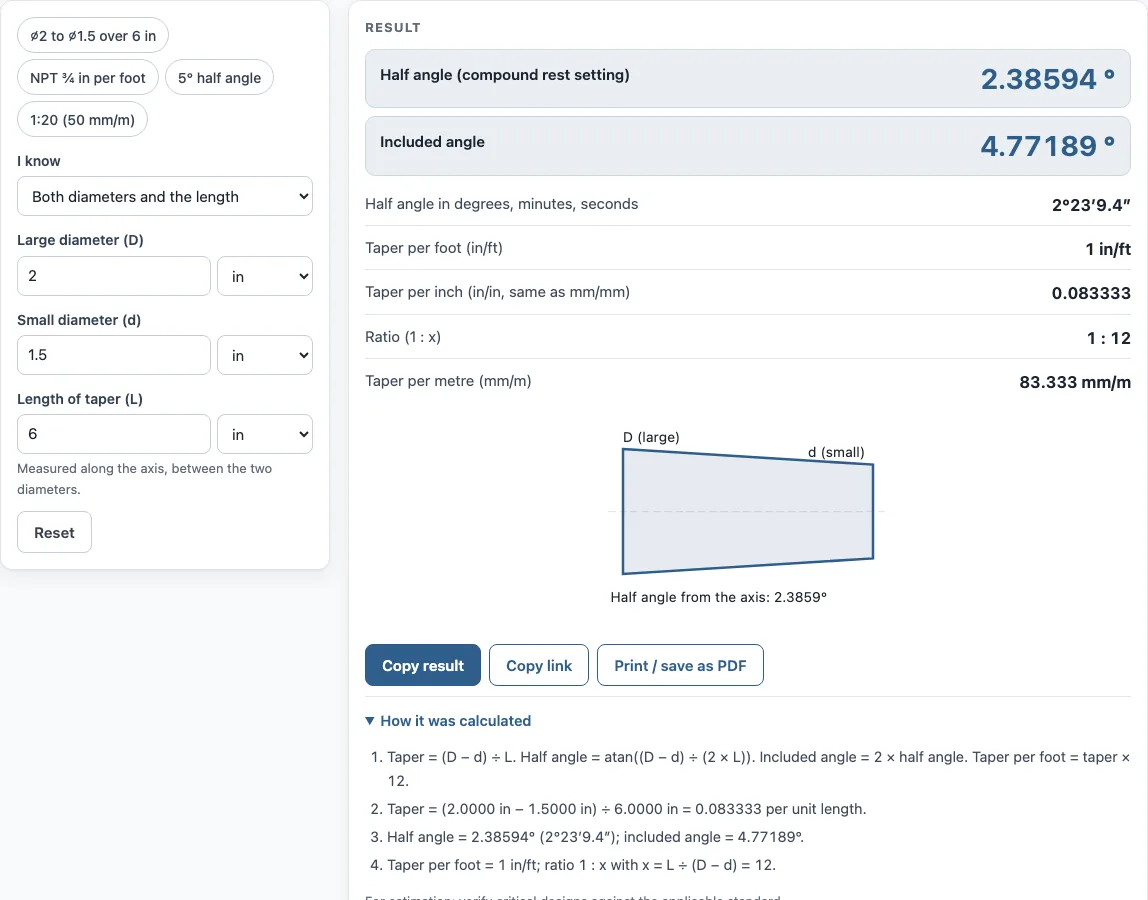
How to use the Taper angle calculator
- Choose the input mode that matches the numbers you have: both diameters and the length, the angle with the length and one diameter, or the taper per foot (in/ft) or per metre (mm/m) with the length and one diameter.
- Enter each value in the field for that mode. Check which diameter is the large one (D) and which is the small one (d).
- If you enter an angle, say whether it is the included angle or the half angle, and choose the matching option. The two differ by a factor of two.
- Read the results. You get the half angle in decimal degrees and in degrees, minutes and seconds, the included angle, the taper per foot, the taper per inch, the ratio and the mm/m value. In the second and third modes, the missing large or small diameter also appears.
- Look for warnings. Equal diameters mean there is no taper. An included angle above 60° describes a steep cone rather than a taper.
- Open “How it was calculated” to see each step with your numbers, and compare them with the side view drawing.
Copy result copies the result lines with a link to the calculation. Copy link copies the page address, which stores every input, so opening it later restores the same calculation. Print / save as PDF prints the inputs, results, calculation steps and the date.
How do you calculate taper angle?
The half angle is arctan of (D − d) divided by (2L), where D is the large diameter, d is the small diameter and L is the length between them. The included angle is twice the half angle.
For example, a taper from ⌀2 in to ⌀1.5 in over 6 in has a difference of 0.5 in. Dividing by 2 × 6 gives 0.04167, and the arctangent of that is a half angle of 2.3859°. The included angle is 4.7719°.
What is the formula for taper per foot?
Taper per foot is (D − d) ÷ L × 12 when the dimensions are in inches. The taper per inch is (D − d) ÷ L, which is the same number as mm per mm when the dimensions are in millimetres.
Using the same ⌀2 to ⌀1.5 in example, 0.5 ÷ 6 × 12 gives 1 in/ft. For metric work, the mm/m value is (D − d) ÷ L × 1000. A taper from ⌀40 mm to ⌀30 mm over 200 mm gives 10 ÷ 200 = 0.05, which is 50 mm/m, or 0.6 in/ft.
How do you set the compound for a taper?
Set the compound to the half angle, not the included angle. The half angle is the compound rest or taper attachment setting on a lathe.
For the 1 in/ft example above, the compound is set to 2.3859°. If your dial reads in degrees, minutes and seconds, use the conversion the tool gives for that value, which is 2°23′9″.
What is the taper angle of NPT threads?
NPT pipe threads taper 3/4 in per foot, which is a ratio of 1:16. Their half angle is 1.7899°, or 1°47′24″.
You can use this value directly without calculating it, since it is a fixed standard for the thread form.
How do you convert a taper ratio to an angle?
For a ratio of 1 : x, the taper per inch is 1/x, so the half angle is arctan of 1 ÷ (2x). The included angle is twice that.
For a 1:20 ratio, 1 ÷ 40 gives a half angle of 1.4321° and an included angle of 2.8642°. To go the other way, the ratio is x = L ÷ (D − d).
Sources
- Taper per foot, half angle atan((D − d) ÷ 2L) and ratio 1:x from plane trigonometry
- 1 in = 25.4 mm exactly (NIST SP 811)
Worked examples
| Input | Result |
|---|---|
| D 2 in, d 1.5 in, length 6 in | Half angle 2.3859°, included 4.7719°, 1 in/ft |
| D 40 mm, d 30 mm, length 200 mm | Half angle 1.4321°, included 2.8642°, 0.6 in/ft |
| 0.75 in/ft over length 0.5 in | Half angle 1.7899°, included 3.5798°, 0.75 in/ft |
| 5° half angle (one side from the axis), length 2 in | Half angle 5°, included 10°, 2.1 in/ft |
| 50 mm/m over length 100 mm | Half angle 1.4321°, included 2.8642°, 0.6 in/ft |
Calculated by the tool above with these values.
Frequently asked questions
Is taper measured on the diameter or the radius?
Taper per foot is measured on the diameter. If you use radii instead, the result is half the correct size, so enter the diameters.
What does the warning for an included angle above 60° mean?
It means the shape is a steep cone rather than a taper. Check whether the figure you entered is the included angle or the half angle, since the two are often confused.
Can I use the results on quotes or shop paperwork?
Yes. Results may be used in commercial work such as quotes, shop travelers, setup sheets, inspection reports and customer documents without attribution.
Does the calculator work on a phone?
Yes, it works on a phone as well as a computer.
What if I only know the taper per foot?
Choose the taper per foot or per metre mode, then enter the length and one diameter. The tool finds the missing diameter and the angle values.
How do I convert taper per foot to an angle?
Divide the taper per foot by 24 and take the arctangent to get the half angle; double it for the included angle. For 3/4 in per foot, arctan(0.75 ÷ 24) = 1.7899°, the NPT half angle.
Related tools
- Sine bar calculator: use it to set an angle on a workpiece with gauge blocks.
- NPT tap drill chart: use it to find the drill size before cutting NPT pipe threads.
- Chamfer calculator: use it to work out the size and angle of an edge chamfer.
- Countersink depth calculator: use it to find how deep a countersink cut will go.
- SFM calculator: use it to convert surface feet per minute to spindle speed for a cut.
- Thermal expansion calculator: use it to see how much a part grows or shrinks with temperature.
- All machining calculators: use it to browse every calculator on the site.