Speeds and Feeds Calculator
Enter the tool diameter, cutting speed and chip load from your tooling supplier to get spindle RPM and feed rate.
A speeds and feeds calculator works out the spindle speed (rpm) and feed rate for a cutting tool from its diameter, cutting speed and chip load. This tool covers milling with end mills and face mills, drilling, and turning on a lathe, and it shows results in both inch and metric units. It runs in your browser, is free, and needs no sign-up.
Results update as you type, so you can change one value and see its effect right away. Use it to set up a mill, drill press, CNC router or lathe, or to check numbers before a job runs. It also works on a phone, which is handy at the machine.
How to use the Speeds and Feeds Calculator
- Select the operation: milling (end mill or face mill), drilling, or turning.
- Pick in or mm (and SFM or m/min) in the unit box next to each value; units can be mixed.
- Enter the tool diameter. For turning, enter the workpiece diameter instead.
- Enter the cutting speed in SFM or m/min.
- For milling, enter the number of flutes and the chip load per tooth. For drilling and turning, enter the feed per revolution.
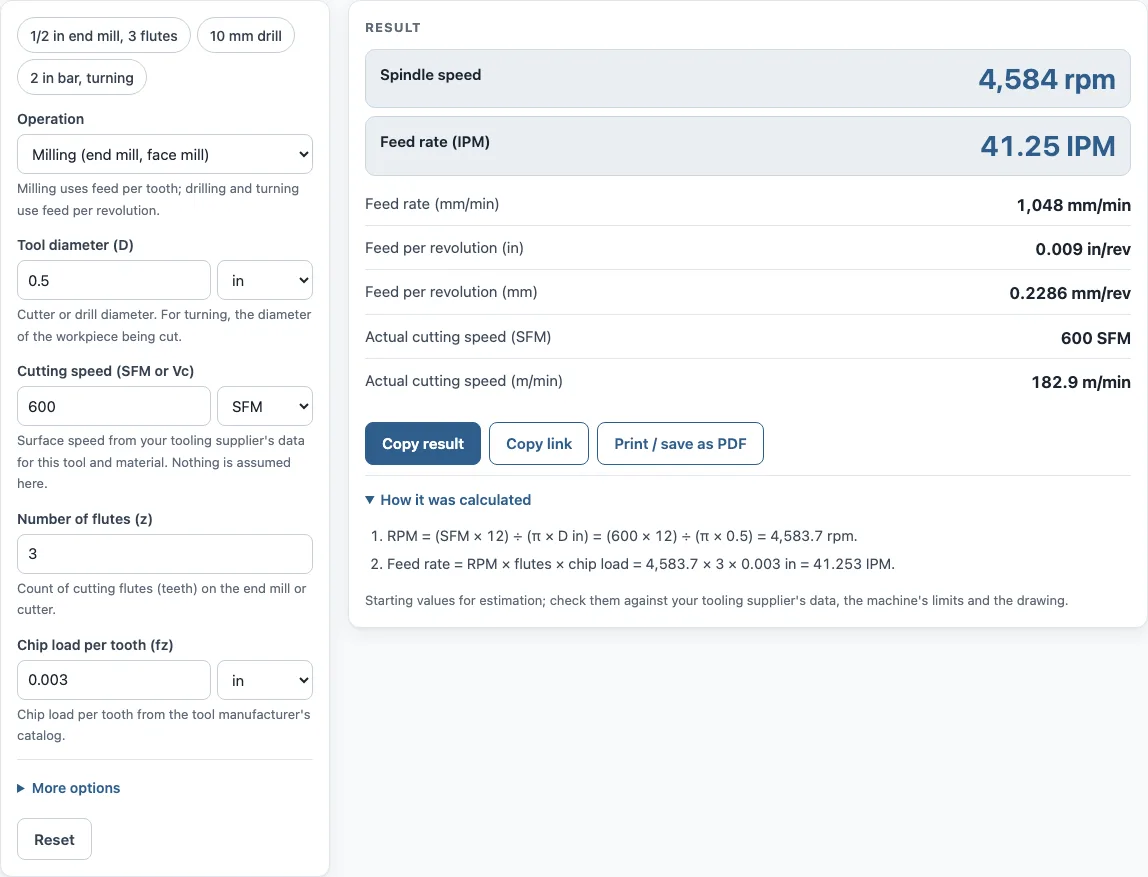
- Read the results: spindle speed in rpm, feed rate in IPM and mm/min, feed per revolution in inches and mm, and the actual cutting speed in SFM and m/min.
- Optionally, enter a maximum spindle speed, or an axial depth and radial width of cut to see the metal removal rate in in³/min and cm³/min.
- Read any warning before you use the numbers.
Presets load example inputs, such as a 1/2 in 3-flute end mill at 600 SFM and 0.003 in per tooth. Change them to match your own job. “How it was calculated” lists the formula and each step with your numbers. Copy result copies the result lines with a link. Copy link copies the page address, which stores every input, so opening it later restores the same calculation. Print / save as PDF prints the inputs, results, calculation steps and the date.
What is the formula for speeds and feeds?
Spindle speed in rpm equals the cutting speed times 12, divided by π times the diameter in inches: RPM = SFM × 12 ÷ (π × D). This is often written as RPM ≈ 3.82 × SFM ÷ D. For metric work, use RPM = Vc × 1000 ÷ (π × D in mm), with Vc in m/min.
Surface feet per minute (SFM) is how fast the edge of the tool moves across the material. At the same cutting speed, a larger diameter gives a lower rpm, so doubling the diameter halves the rpm. For example, a 1/2 in tool at 600 SFM gives 600 × 12 ÷ (π × 0.5) = 4,584 rpm. To go the other way, use SFM = RPM × π × D ÷ 12.
Feed rate is the speed at which the table or workpiece moves. For milling, feed rate = RPM × number of flutes × chip load per tooth. For drilling and turning, feed rate = RPM × feed per revolution.
How do you calculate feed rate for milling?
Multiply the spindle speed by the number of flutes and by the chip load per tooth. Feed rate in inches per minute (IPM) is then RPM × flutes × chip load.
Using the 1/2 in example above with 3 flutes and 0.003 in per tooth:
- Spindle speed: 4,584 rpm.
- Multiply by the flute count: 4,584 × 3 = 13,752 tooth passes per minute.
- Multiply by the chip load: 13,752 × 0.003 = 41.25 IPM.
- Convert to metric: 41.25 × 25.4 ≈ 1,048 mm/min.
The calculator uses the same steps, so its result matches this check. A 10 mm cutter at 100 m/min gives 3,183 rpm and 25.06 IPM (636.6 mm/min).
How do you calculate speeds and feeds for drilling?
Drilling uses the same speed formula with the drill diameter, but the feed is given per revolution instead of per tooth. Feed rate = rpm × feed per revolution. A 10 mm drill at 25 m/min turns at 795.8 rpm; at 0.15 mm/rev that is 119.4 mm/min (4.7 IPM). Use this quick speed and feed calc at the machine whenever you change the drill size, because a smaller drill needs a higher rpm for the same cutting speed.
Sources
- Sandvik Coromant, milling formulas and definitions — table feed, chip thinning and metal removal rate
- Sandvik Coromant, turning formulas and definitions — cutting speed, feed and removal rate in turning
- No cutting speeds or chip loads are built in: use your tooling supplier’s data
- 1 in = 25.4 mm exactly (NIST SP 811)
Worked examples
| Input | Result |
|---|---|
| Milling, cutter 0.5 in at 600 SFM | 4,584 rpm, 41.25 IPM (1,048 mm/min) |
| Milling, cutter 10 mm at 100 m/min | 3,183 rpm, 25.06 IPM (636.6 mm/min) |
| Drilling, drill 10 mm at 25 m/min | 795.8 rpm, 4.699 IPM (119.4 mm/min) |
| Turning, workpiece 2 in at 400 SFM | 763.9 rpm, 6.112 IPM (155.2 mm/min) |
| Milling, cutter 0.25 in at 800 SFM | 12,000 rpm, 48 IPM (1,219 mm/min) |
Calculated by the tool above with these values.
Frequently asked questions
What is chip load (feed per tooth)?
Chip load is the thickness of material that each cutting edge removes in one revolution of the cutter. It is set per tooth, so the total feed rate depends on how many flutes the cutter has. Your tooling supplier’s catalog gives the correct value for each tool and material.
How do you calculate speeds and feeds for a lathe?
Select turning and enter the workpiece diameter, the cutting speed in SFM or m/min, and the feed per revolution. The calculator then gives rpm and feed rate in IPM and mm/min. For example, a 2 in bar at 400 SFM gives 763.9 rpm and 6.112 IPM (155.2 mm/min) at 0.008 in per revolution.
How do you calculate drill feed and speed?
Select drilling and enter the drill diameter, the cutting speed, and the feed per revolution. The rpm comes from the speed formula, and the feed rate equals rpm × feed per revolution. A 10 mm drill at 25 m/min with 0.15 mm/rev gives 795.8 rpm and 119.4 mm/min.
Does the calculator include cutting speeds for materials?
No. The tool has no built-in speeds for materials. Enter the cutting speed and chip load (or feed per revolution) from your tooling supplier’s catalog for the tool and material you are cutting.
Does this work for a CNC router or wood router?
Yes. The same formulas apply to a CNC router or wood router. Only the chip load and speed values change, and these come from the cutter maker.
Why does the calculator show a warning?
Warnings flag values that are often a unit mix-up. They appear for very high rpm, a chip load above 25% of the cutter diameter, a feed per revolution above half the diameter, and a cutting speed above 10,000 SFM. Check the units and inputs before you run the job.
Related tools
- SFM calculator: use it when you know the rpm and need the cutting speed, or the other way round.
- Chip load calculator: use it to find the chip load per tooth for a given feed rate.
- Material removal rate calculator: use it to find how fast metal comes off once you have set depth and width of cut.
- Surface finish calculator: use it to estimate the finish your feed rate will leave.
- Drill and tap chart: use it to pick the right drill and tap size for a hole.
- Drill size chart: use it to look up a drill’s diameter in fractional, number, letter and metric sizes.
- G code list: use it to look up the G-codes and M-codes in your program.
- All machining calculators: use it to browse every calculator on the site.