SFM Calculator (RPM ↔ Surface Speed)
Convert cutting speed in SFM or m/min to spindle RPM for a tool or part diameter, or work out the surface speed from RPM.
This SFM calculator converts cutting speed, in surface feet per minute (SFM, also written SFPM) or metres per minute, into spindle speed in revolutions per minute (rpm), and back again. Use it for milling, drilling and turning, including on CNC machines. It is free, needs no sign-up, runs in your browser and works on a phone. Results update as you type, so you can change a diameter or speed and see the new rpm straight away.
A table under the result lists the rpm for common tool sizes at the same cutting speed.
Nothing is assumed about the material: you bring the cutting speed from your tooling data.
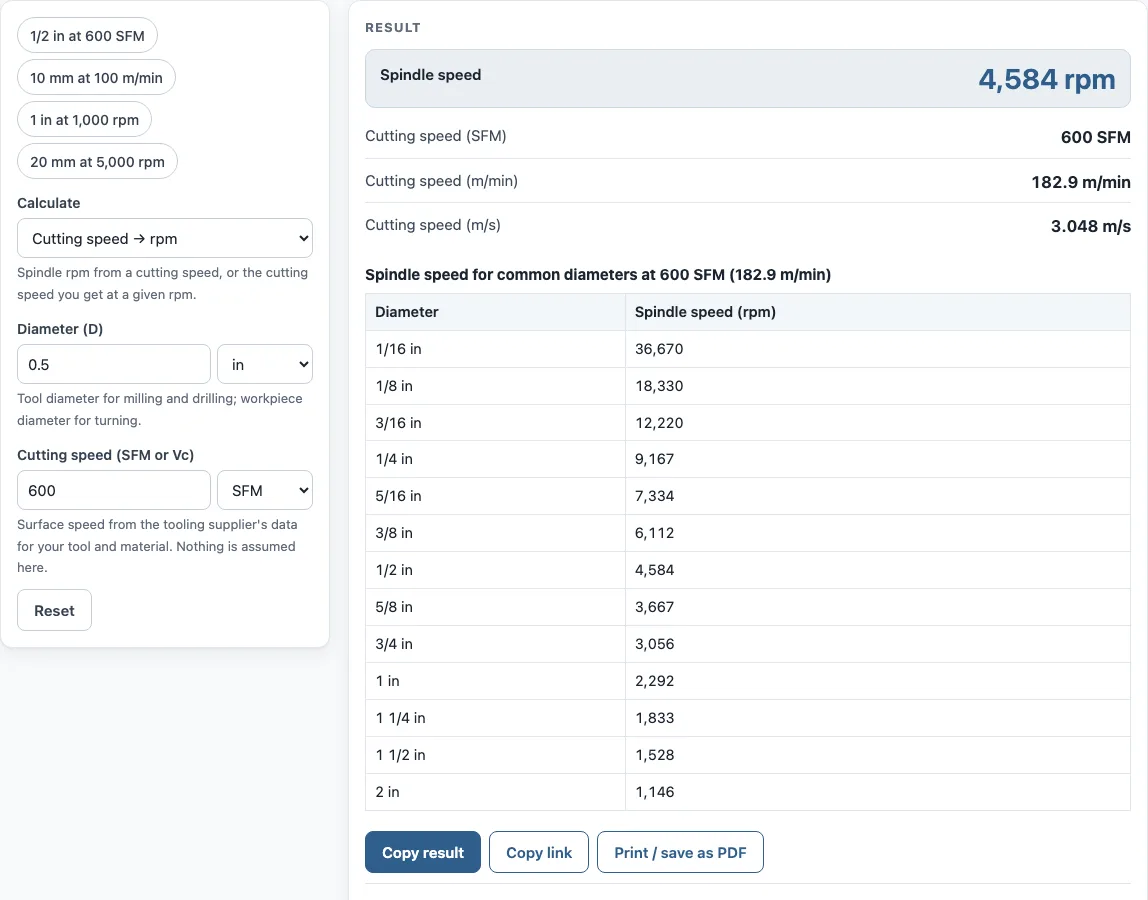
How to use the SFM calculator
- Choose the mode. Pick cutting speed → rpm if you know the cutting speed and need the spindle speed. Pick rpm → cutting speed if the machine already runs at a set rpm and you want the surface speed.
- Enter the diameter. For a milling cutter or drill, enter the tool diameter. For turning, enter the workpiece diameter. Select inches or mm to match the number you typed.
- Enter the cutting speed in SFM or m/min, or enter the rpm, depending on the mode. The tool has no built-in material speeds, so take the recommended surface speed from your tooling supplier for your tool and material.
- Read the result. The rpm, SFM, m/min and m/s appear together.
- Check the table under the result. It lists the rpm at your cutting speed for common diameters: 1/16 to 2 in, or 1 to 50 mm.
- Read any warning. A warning appears when the rpm is higher than most spindles can run, or when the cutting speed is above 10,000 SFM, which usually means a unit mix-up.
- Open “How it was calculated” to see the formula and each step with your numbers.
Copy result copies the result lines with a link. Copy link copies the page address, which stores every input, so opening it later restores the same calculation. Print / save as PDF prints the inputs, results, calculation steps and the date.
How do you convert SFM to RPM?
Divide the cutting speed by the distance around the tool or workpiece, using matching units. The formula is RPM = SFM × 12 ÷ (π × D in inches). The circumference in inches is π × D. SFM is measured in feet, so multiplying by 12 turns it into inches per minute. Dividing inches per minute by the circumference in inches gives revolutions per minute.
In a shop, the shortcut RPM ≈ 3.82 × SFM ÷ D gives nearly the same answer. For a 1/2 in diameter at 600 SFM, the full formula gives 600 × 12 ÷ (π × 0.5) = 4,584 rpm, and the shortcut gives the same figure.
For metric work, use RPM = Vc × 1000 ÷ (π × D in mm), where Vc is the cutting speed in m/min. A 10 mm tool at 100 m/min runs at 3,183 rpm.
To go the other way, use SFM = π × D × RPM ÷ 12. A 1 in diameter at 1,000 rpm gives 261.8 SFM, or 79.8 m/min. Since 1 SFM equals 0.3048 m/min, 100 m/min is about 328 SFM.
What is surface feet per minute?
Surface feet per minute is the distance the cutting edge travels across the work surface in one minute, measured in feet. It is the cutting speed. Spindle speed is a different quantity: it counts how many full revolutions the spindle makes in one minute.
The two are linked through diameter. A given SFM needs more rpm on a smaller diameter, because a small tool makes a shorter circle with each turn. At 600 SFM, a 1/4 in tool needs about 9,168 rpm, while a 1/2 in tool needs 4,584 rpm. Keeping the surface speed the same is what protects the cutting edge, which is why the calculator starts from the cutting speed and works out the rpm for your diameter.
Sources
- Sandvik Coromant, turning formulas and definitions — cutting speed, feed and removal rate in turning
- SFM = π × D × RPM ÷ 12 and Vc = π × D × RPM ÷ 1000 (1 ft = 0.3048 m)
- 1 in = 25.4 mm exactly (NIST SP 811)
Worked examples
| Input | Result |
|---|---|
| D = 0.5 in, cutting speed 600 SFM | 4,584 rpm |
| D = 10 mm, cutting speed 100 m/min | 3,183 rpm |
| D = 1 in, 1000 rpm | 261.8 SFM (79.8 m/min) |
| D = 20 mm, 5000 rpm | 1,031 SFM (314.2 m/min) |
Calculated by the tool above with these values.
Frequently asked questions
How do you calculate drill speed?
Enter the drill diameter and the surface speed for the drill and material from your tooling supplier. The calculator then gives the spindle speed. For a quick check, use RPM ≈ 3.82 × SFM ÷ D with D in inches.
What is the cutting speed formula for milling?
It is the same formula as for drilling and turning. For milling, the diameter is the cutter diameter, so a 1 in cutter at 300 SFM needs about 1,146 rpm. Use the cutter diameter, not the diameter of the part.
How do you calculate lathe rpm?
On a lathe, the diameter is the workpiece diameter, not the tool. Enter that diameter and the cutting speed for the material, and the calculator returns the spindle rpm. Choose the rpm → cutting speed mode when you need to check the speed at a fixed spindle setting.
Why does the tool show a warning?
A warning means the rpm is higher than most spindles can run, or the cutting speed is above 10,000 SFM. In most cases the diameter or speed was entered in the wrong unit, so check the unit selectors first.
Can I use the results on customer documents?
Yes. Results may be used in commercial work, including quotes, shop travelers, setup sheets, inspection reports and customer documents, without attribution.
Are my numbers uploaded anywhere?
No. Everything runs in your browser, and nothing you enter is uploaded.
Related tools
- Speeds and feeds calculator: use it when you need feed rate as well as spindle speed.
- Chip load calculator: use it to find the feed per tooth once you have the rpm.
- Material removal rate calculator: use it to estimate how fast material comes off at your settings.
- Drill size chart: use it to look up a drill diameter before you enter it here.
- Surface finish calculator: use it to estimate the finish your feed and tool radius will leave.
- All machining calculators: use it to find other calculators for shop work.