Material Removal Rate Formula and Calculator
Get the material removal rate (MRR) for a milling, turning or drilling cut, and an estimate of spindle power if you know the unit power.
The material removal rate formula is the volume of the cut per minute: depth × width × feed rate for milling, cutting speed × feed × depth for turning, and hole area × feed for drilling. This material removal rate calculator finds how fast a cutting tool removes metal, in cubic inches per minute and cubic centimetres per minute, for milling, turning or drilling. Enter the depth, width, speed and feed for your operation, and it returns the rate as you type. It runs in your browser, is free, and needs no sign-up.
Metal removal rate is the same quantity as material removal rate. Shops use it to compare machining strategies, such as a deep, narrow milling cut against a shallow, wide one. You can also use it to check whether a spindle has enough power for the cut. The calculator works on a phone as well as a desktop.
How to use the Material removal rate calculator
- Choose the operation: milling, turning or drilling.
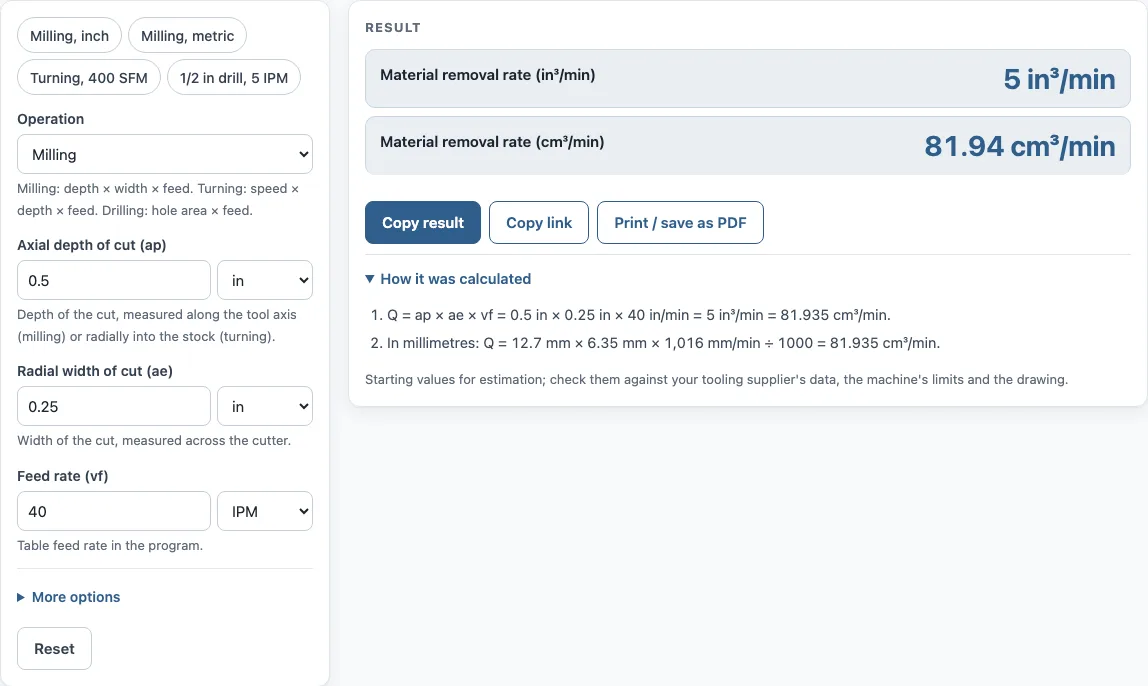
- Enter the values for that operation. For milling, type the axial depth of cut (ap), the radial width of cut (ae) and the feed rate (vf). For turning, type the cutting speed, the feed per revolution and the depth of cut. For drilling, type the drill diameter (D) and the feed rate.
- Read the result in in³/min and cm³/min. It updates as you type, so you do not need a separate button.
- If a warning appears in turning, check your numbers. It shows when the feed per revolution is larger than the depth of cut, which is usually a unit mistake.
- Optionally, type a unit power in hp per in³/min or kW per cm³/min. The calculator then shows cutting power in kW and hp. Get this value from your tooling or material supplier, because no unit power values are built in.
- Open “How it was calculated” to see the formula and each step with your numbers.
Copy result copies the result lines with a link. Copy link copies the page address, which stores every input in the link, so opening it later restores the same calculation. Print / save as PDF prints the inputs, results, calculation steps and the date.
What is the material removal rate formula?
Material removal rate (MRR) is the volume of metal removed per unit time. It equals the cross-sectional area of the cut multiplied by how fast the tool moves through the material, so the result is a volume per minute.
How do you calculate metal removal rate in milling?
Multiply the axial depth of cut (ap) by the radial width of cut (ae) and the feed rate (vf): MRR = ap × ae × vf. For example, a 0.5 in deep, 0.25 in wide cut at 40 IPM removes 5 in³/min, which is 81.94 cm³/min. Use consistent units, or convert to cm³/min at the end.
What is the material removal rate formula for a lathe?
In turning, MRR equals cutting speed × feed per revolution × depth of cut. In metric units, Q (cm³/min) = vc (m/min) × ap (mm) × f (mm/rev). In inch units, MRR (in³/min) = 12 × SFM × f (in/rev) × depth (in). A turn at 200 m/min, 2 mm deep and 0.2 mm/rev gives 80 cm³/min.
How do you calculate material removal rate for drilling?
Multiply the cross-sectional area of the hole by the feed rate: MRR = (π × D² ÷ 4) × feed rate. The area term is the circle of the drill. A 1/2 in drill at 5 IPM removes about 0.98 in³/min.
How do you estimate spindle power from MRR?
Multiply the MRR by a specific cutting energy, which the calculator calls unit power: power = MRR × unit power. The unit power depends on the material and tooling, so use a value from your supplier. The result is power at the cut, and the machine needs more to cover drive losses.
Sources
- Sandvik Coromant, milling formulas and definitions — table feed, chip thinning and metal removal rate
- Sandvik Coromant, turning formulas and definitions — cutting speed, feed and removal rate in turning
- 1 hp = 745.69987158 W (NIST SP 811)
Worked examples
| Input | Result |
|---|---|
| Milling, ap 0.5 in, ae 0.25 in, feed 40 IPM | 5 in³/min (81.94 cm³/min) |
| Milling, ap 5 mm, ae 10 mm, feed 500 mm/min | 1.526 in³/min (25 cm³/min) |
| Turning, 400 SFM, ap 0.1 in, f 0.01 in/rev | 4.8 in³/min (78.66 cm³/min) |
| Turning, 200 m/min, ap 2 mm, f 0.2 mm/rev | 4.882 in³/min (80 cm³/min) |
| Drilling, D 0.5 in, feed 5 IPM | 0.9817 in³/min (16.09 cm³/min) |
Calculated by the tool above with these values.
Frequently asked questions
Is metal removal rate the same as material removal rate?
Yes. The two terms describe the same quantity, the volume of metal removed per minute. This calculator uses both names.
Where do I get the unit power value?
Use the value from your tooling or material supplier, since the calculator has no built-in unit power values. Enter it in hp per in³/min or kW per cm³/min to get the cutting power.
Does the power result include machine losses?
No. It shows the power at the cut, and the machine will need more power to cover drive losses. Plan your spindle size with that margin in mind.
Can I use the results in customer documents?
Yes. Results may be used in commercial work, such as quotes, shop travelers, setup sheets, inspection reports and customer documents, without attribution.
Why is MRR useful when I compare tool paths?
Two tool paths that remove the same volume can take very different times. Comparing MRR (in³/min or cm³/min) shows which strategy removes the stock faster, for example a deep, narrow high-efficiency cut against a shallow, wide one.
Can I mix inch and metric inputs?
Yes. Each value has its own unit select, and the result is always shown in both in³/min and cm³/min.
Related tools
- Speeds and feeds calculator: use it to set spindle speed and feed before you check the removal rate.
- Chip load calculator: use it to check the feed per tooth or per revolution for your cut.
- SFM calculator: use it to convert between RPM and surface feet per minute.
- Surface finish calculator: use it to estimate the finish your feed and nose radius will produce.
- Drill size chart: use it to find the drill diameter (D) for a hole size.
- All machining calculators: use it to browse every calculator on the site.