#6 Screw Diameter and Machine Screw Size Chart
Type a screw number such as #6 or a fraction such as 1/4 to get its diameter in inches and mm, the coarse and fine thread pitches and the tap drill.
A #6 screw measures 0.138 in across, or 3.505 mm. Use this machine screw size chart to look up the major diameter for any number size, plus the coarse (UNC) and fine (UNF) threads per inch and the tap drill for each.
Start typing a size into the Screw size box and the results refresh with each keystroke. For #6, the output shows the diameter, a UNC thread of 32 threads per inch with a #36 tap drill, and a UNF thread of 40 threads per inch with a #33 tap drill.
Everything runs locally in your browser. There is no cost, no account to create, and it also works on a phone.
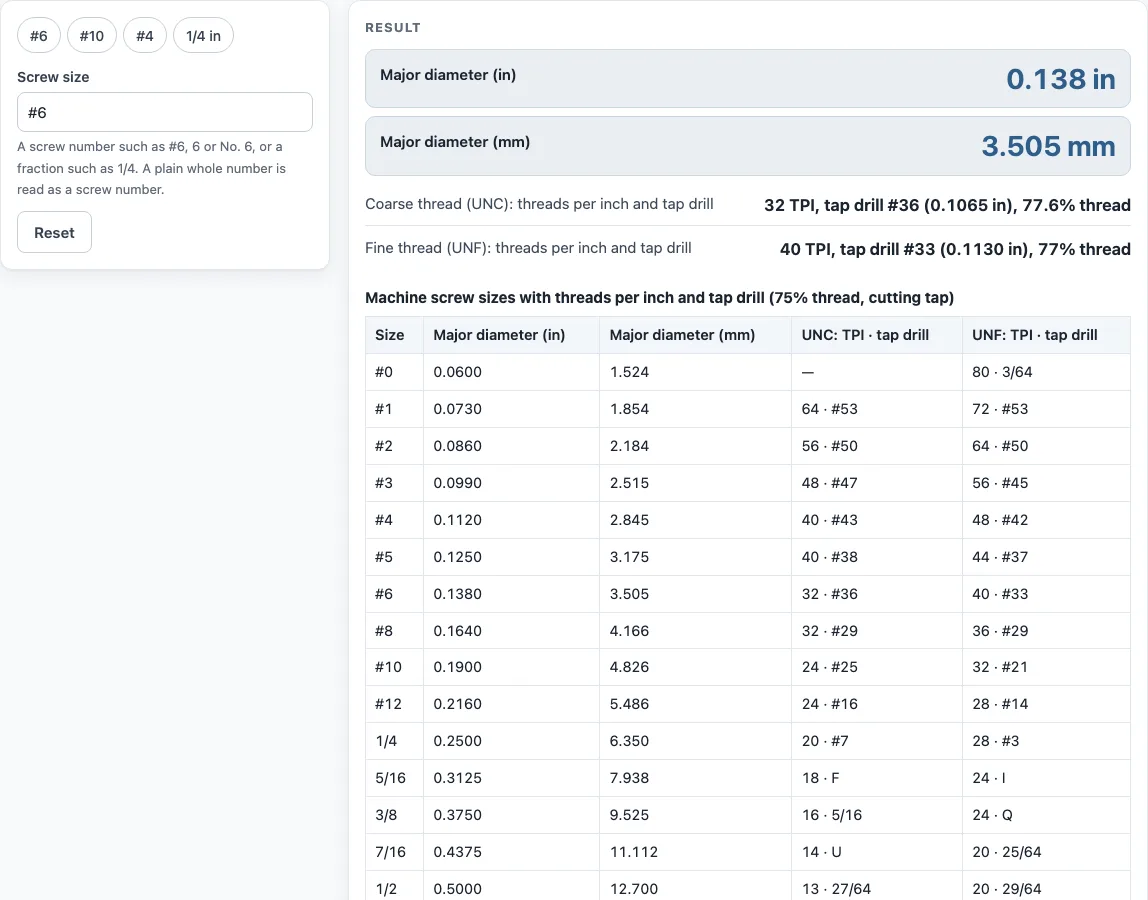
How to use the machine screw size chart
- Type your size into the Screw size box. You can enter a screw number such as #6, 6 or No. 6, a fraction or decimal such as 1/4 or 0.25, or thread text such as 6-32.
- For a common size, pick one of the presets: #6, #10, #4 or 1/4 in.
- The major diameter appears in the large rows, given in inches and in millimetres.
- Look at the coarse thread (UNC) row for threads per inch, tap drill and % thread.
- Review the fine thread (UNF) values the same way. When no series is listed for a size, the result states that no standard size is available.
- Below the result, scroll the machine screw size chart to compare sizes #0 to #12 and 1/4, 5/16, 3/8, 7/16 and 1/2 in. Since each row lists the tap drill, the chart also works as a screw to drill bit guide. Dashes mark sizes with no listed series.
- Open How it was calculated to view the formula along with each step solved using your values.
Copy result places the result lines on your clipboard along with a link. Copy link grabs the page address, which saves every input so that reopening it brings back the same calculation. Print / save as PDF outputs the inputs, results, calculation steps and date, which is handy for setup sheets and inspection records.
What is the diameter of a #6 screw?
A #6 screw has a major diameter of 0.138 in, or 3.505 mm. The major diameter is the distance across the outside of the threads, and for number sizes a single formula gives it.
That formula is major diameter = 0.060 + 0.013 × the screw number, in inches. For #6, 0.013 × 6 = 0.078, and 0.060 + 0.078 = 0.138 in. Converting to millimetres means multiplying by 25.4, since 1 in = 25.4 mm: 0.138 × 25.4 = 3.505 mm.
How do you calculate the diameter of a screw number?
Multiply the screw number by 0.013, add 0.060, and the result is the major diameter in inches. Multiply that figure by 25.4 to get millimetres. You can work through the steps yourself for any number size:
- Multiply the screw number by 0.013.
- Add 0.060 to that result. The total is the major diameter in inches.
- Multiply by 25.4 to convert to millimetres.
For #4: 0.013 × 4 = 0.052, then 0.052 + 0.060 = 0.112 in, and 0.112 × 25.4 = 2.845 mm. For #0, the formula returns just 0.060 in, which is the start of the scale.
Odd sizes such as #7, #9 and #11 follow the same formula, so each still gets a diameter. The tool notes that no standard size appears for them because they lack a UNC or UNF pitch in the Unified Thread Standard table it relies on. Numbers above #12 trigger a warning.
How do you read a screw size such as #6-32?
The first part is the screw number, which sets the diameter. The second part gives the threads per inch. In #6-32 the diameter is 0.138 in and there are 32 threads per inch, so the pitch is 1 ÷ 32 = 0.03125 in, or 0.794 mm. Made in the fine series, that #6 screw is also available as #6-40, with a pitch of 0.025 in.
What are the tap drills for #10-24 and #10-32?
A #10 screw has a 0.190 in major diameter. The coarse #10-24 calls for a #25 drill at about 75% thread. The fine #10-32 uses a #21 drill. The chart lists these values, calculated with the same 75% cutting tap formula.
Sources
- Unified Thread Standard (Wikipedia): number-size diameter 0.060 + 0.013 × N in, and UNC and UNF threads per inch (ASME B1.1)
- OSG tap drill size chart (2024): drill = major − 0.01299 × % ÷ TPI
- Drill bit sizes (Wikipedia): number, letter and fractional drill decimals of ASME B94.11M
- 1 in = 25.4 mm exactly (NIST SP 811)
Worked examples
| Input | Result |
|---|---|
| Size #6 | Diameter 0.138 in (3.505 mm); UNC 32 TPI, tap drill #36 (0.1065 in), 77.6% thread |
| Size #10 | Diameter 0.19 in (4.826 mm); UNC 24 TPI, tap drill #25 (0.1495 in), 74.8% thread |
| Size #4 | Diameter 0.112 in (2.845 mm); UNC 40 TPI, tap drill #43 (0.0890 in), 70.8% thread |
| Size 1/4 | Diameter 0.25 in (6.35 mm); UNC 20 TPI, tap drill #7 (0.2010 in), 75.4% thread |
| Size #8 | Diameter 0.164 in (4.166 mm); UNC 32 TPI, tap drill #29 (0.1360 in), 69% thread |
Calculated by the tool above with these values.
Frequently asked questions
What drill size for a #6-32 tap?
Pick a #36 drill, which measures 0.1065 in. The tool subtracts 0.01299 × 75 ÷ 32 from the major diameter to aim for a 75% thread, then selects the nearest standard drill, which gives 77.6% thread. Enter 6-32 in the Screw size box to see this result.
What is the difference between UNC and UNF?
UNC is the coarse series and UNF is the fine series. Both are Unified threads, but UNF packs more threads per inch into the same diameter. For #6, UNC is 32 threads per inch and UNF is 40.
What size is a #10 screw in mm?
A #10 screw has a major diameter of 0.190 in, equal to 4.826 mm. The large rows of the result show this value.
Does this tool work for metric screws?
It does not. It covers number sizes and fractional inch sizes only. Metric threads are found on the Drill and tap chart on the home page.
Why does a size like #7 show no standard thread?
The diameter for #7 comes from the same relation used for other number sizes. However, UNC and UNF pitches are listed only for sizes that have a standard series, so the tool shows the diameter and notes that no standard size is listed.
Can I type a thread such as 10-32 into the Screw size box?
Yes. The tool reads the screw number from the start of the text, so 10-32 gives the #10 diameter and shows both the coarse and fine threads for that size.
Is the tap drill for a forming tap?
It is not. The tap drills here are for a cutting tap at 75% thread. For a forming tap, which needs a different hole size, check the Drill and tap chart on the home page and select the forming tap option.
Related tools
- Drill and tap chart: Tap drill sizes for UNC, UNF and metric threads all sit on this one page.
- Drill size chart: Handy for finding what a number, letter, fractional or metric drill measures.
- Thread pitch calculator: Works out pitch diameter, minor diameter or thread depth for you.
- Decimal to fraction inches: A decimal such as 0.138 goes in, and the nearest fraction comes out.
- Countersink depth calculator: Sets the depth you need when a countersunk screw is going in.
- All machining calculators: Browse the complete collection of tools here.