Drill Size Chart
Every number, letter, fractional and metric drill with its size in inches and millimetres. Type a size to see the nearest drills.
The drill size chart is a free tool that tells you which standard drill matches a size you enter, and it lists every standard drill in inches and millimetres. It covers 386 drills: fractional drills from 1/64 to 2 in, number drills #1 to #80, letter drills A to Z, and metric drills from 0.3 to 25 mm. It runs in your browser with no sign-up and works on a phone.
Use it to check a tap drill, a bolt or screw hole, or a metric size. If no standard drill matches exactly, it shows the nearest drills on each side and how far off each one is.
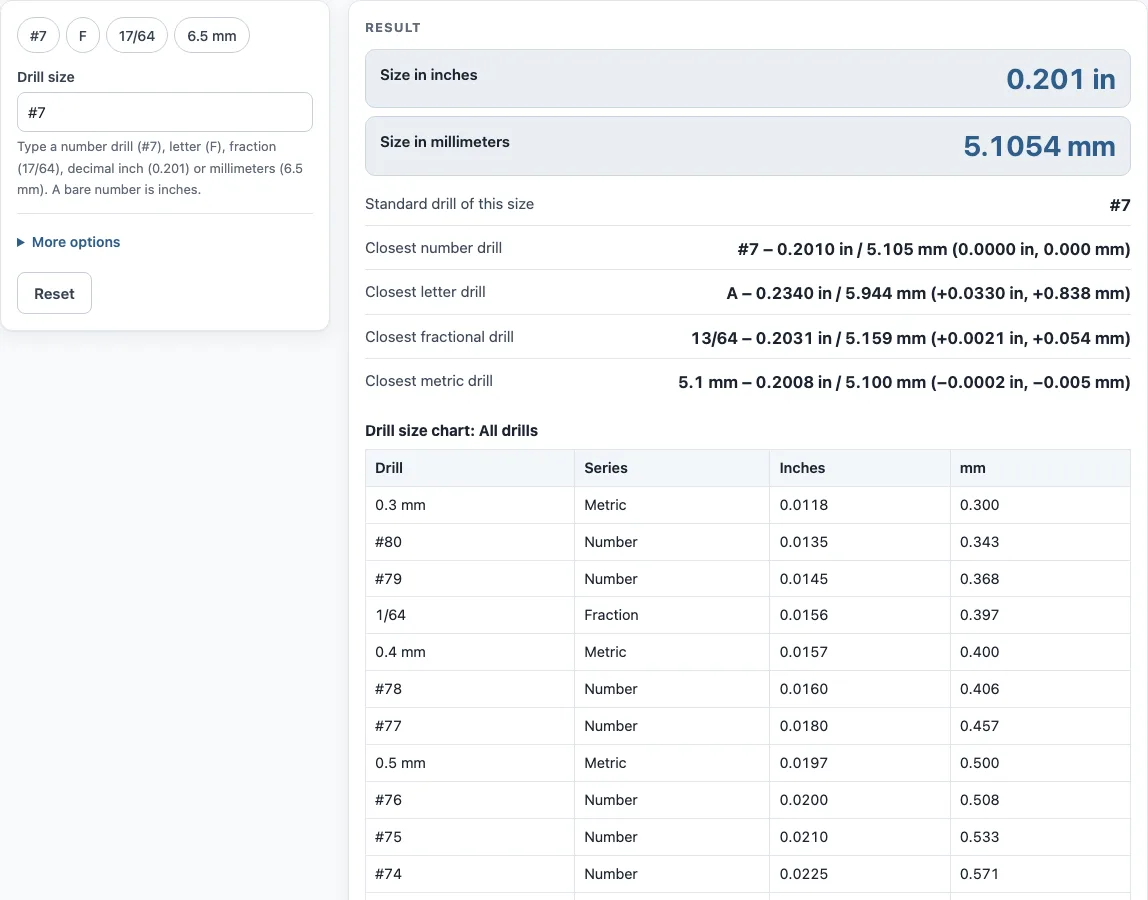
How to use the Drill size chart
- Click the Drill size box at the top of the tool.
- Type a size. You can enter a number drill (#7), a letter (F), a fraction (17/64), a decimal inch (0.201) or millimetres (6.5 mm). A bare number is read as inches.
- Read the result as you type. It shows the size in inches and millimetres, whether a standard drill matches exactly, and the closest number, letter, fractional and metric drills with the difference.
- If no standard drill matches, the tool says so and lists the nearest drills on each side.
- Open How it was calculated to see the formula and each step with your numbers.
- Scroll to the table, which lists the drills sorted by size with name, series, inch and mm. Use the select to show all drills, or only number, letter, fractional or metric drills.
Copy result copies the result lines with a link. Copy link copies the page address, which stores every input, so opening it later restores the same calculation. Print / save as PDF prints the inputs, results, calculation steps and the date.
Tip: the closest drill in each series is shown even when your size is a standard drill, so you can see at once which number, letter or metric drill can replace a fractional one.
What are number drill sizes in inches?
Number drills are labelled #1 to #80, and the higher the number, the smaller the drill. #1 is the largest number drill at 0.228 in, and #80 is the smallest drill in the chart at 0.0135 in. They follow the ASME B94.11M twist drill series.
What size is an F drill?
An F drill is 0.257 in, or 6.528 mm. It is a letter drill. Letter drills run from A (0.234 in) to Z (0.413 in), and they continue the sequence above #1.
Number and letter drills fill the gaps between fractional sizes. That is why tap drill charts use them: a 5/16-18 thread takes an F drill.
What is the decimal size of a #7 drill?
A #7 drill is 0.201 in, which is 5.105 mm. Type #7 into Drill size and the result confirms it is an exact standard drill. It is also the tap drill for a 1/4-20 thread.
How do I convert a drill size to mm?
Multiply inches by 25.4, because 1 inch equals exactly 25.4 mm. For example, 17/64 is 0.265625 in, and 0.265625 × 25.4 = 6.747 mm.
To go the other way, divide millimetres by 25.4. A 6.5 mm drill is 6.5 ÷ 25.4 = 0.2559 in. The tool does both conversions for you, but the formula is useful when you check a drawing by hand.
What is the closest metric drill to a fractional size?
Convert the fraction to millimetres first. A 1/4 in drill is 6.35 mm, which sits exactly halfway between the 6.3 mm and 6.4 mm metric drills, so either one is 0.05 mm away.
Metric drills step by 0.1 mm from 0.3 to 13 mm, and by 0.5 mm from 13.5 to 25 mm. The gaps are wider above 13 mm, so the closest match can be further off. Type the fraction in Drill size and the result shows the nearest metric drill with the difference.
Can I print the drill size chart?
Yes. Click Print / save as PDF to print or save the current calculation. The printout includes the inputs, the results, the calculation steps and the date. Use Copy link first if you want to reopen the same calculation later.
Sources
- Drill bit sizes (Wikipedia) — number and letter drill decimals of ASME B94.11M, checked size by size
- Fractional drills in 1/64 in steps and metric jobber drills in 0.1 and 0.5 mm steps
- 1 in = 25.4 mm exactly (NIST SP 811)
Worked examples
| Input | Result |
|---|---|
| drill size #7 | 0.201 in / 5.105 mm, standard drill: #7 |
| drill size F | 0.257 in / 6.528 mm, standard drill: F |
| drill size 17/64 | 0.2656 in / 6.747 mm, standard drill: 17/64 |
| drill size 6.5 mm | 0.2559 in / 6.5 mm, standard drill: 6.5 mm |
| drill size 0.198 | 0.198 in / 5.029 mm, standard drill: None – not a standard drill size |
Calculated by the tool above with these values.
Frequently asked questions
Why does 0.198 not match a standard drill?
0.198 in (5.029 mm) is not one of the standard drill sizes in the chart. The tool says no standard drill matches and lists the nearest drill on each side, so you can choose the one that suits your job.
What is the largest drill in the chart?
The largest is the 2 in fractional drill, because fractional drills stop at 2 in. Metric drills stop at 25 mm, which is 0.9843 in, so anything larger than 25 mm is only converted, not listed.
What happens if I type 7 with no symbol?
A bare number is read as inches, so 7 means 7 in, not the number drill #7: the tool converts it and says it is larger than the chart’s drills. Type #7 for the number drill.
What is a tap drill?
A tap drill is the hole size you drill before cutting threads with a tap; a tap and die drill chart pairs each thread with its drill. For example, a 1/4-20 thread uses a #7 drill (0.201 in). Check your thread size against a tap drill chart before drilling.
How precise are the mm and inch values?
The conversions are exact, since 1 inch is exactly 25.4 mm. The values are rounded only for display, to about four significant figures, such as 0.2559 in for 6.5 mm.
Can I use the results in quotes or shop paperwork?
Yes. Results may be used in commercial work, including quotes, shop travelers, setup sheets, inspection reports and customer documents, without attribution.
Related tools
- Drill and tap chart: Use it when you need the tap drill for a thread size, not just a drill size.
- NPT tap drill chart: Use it to find the drill for an NPT pipe thread.
- Decimal to fraction inches: Use it to convert a decimal inch reading to its nearest fraction.
- SFM calculator: Use it to work out drill spindle speed from surface speed.
- Speeds and feeds calculator: Use it to set spindle speed and feed rate for a drilling or milling job.
- Countersink depth calculator: Use it to find how deep to countersink for a given hole.
- Drill point calculator: Use it to find how far the drill tip goes past the full diameter.
- Machine screw size chart: Use it to match a screw number to its diameter and tap drill.
- All machining calculators: Use it to browse every calculator on the site.