Drill Point Calculator
Enter the drill diameter and point angle to get the length of the drill point, then the depth the tip must reach for a full-diameter hole.
The drill point calculator works out the length of the cone-shaped tip on a drill bit and the total depth you need to set so a hole reaches full diameter. Enter the drill diameter, choose the point angle, and pick a blind or through hole, and the results update as you type. It runs in your browser, is free, needs no sign-up, and works on a phone.
Use it when you are programming a blind hole to a set depth, or drilling through plate of a known thickness, and need to know how far the tip travels beyond the full-diameter shoulder. If you searched for a drill tip calculator, this page covers the same calculation, since the tip and the point are the same part of the drill.
How to use the Drill point calculator
- Enter the drill diameter (D) and choose the unit, in or mm.
- Choose the point angle: 118°, 135°, 90°, 150°, or Other angle. For Other angle, type the angle in degrees. It must be above 60° and below 180°.
- Choose Blind hole (full diameter to a depth) or Through hole (material thickness).
- Type the hole depth or material thickness in the Hole depth or material thickness box. This box is optional. Leave it blank if you only want the point length.
- For a through hole, open More options and enter a Breakout clearance if you need extra depth past the point.
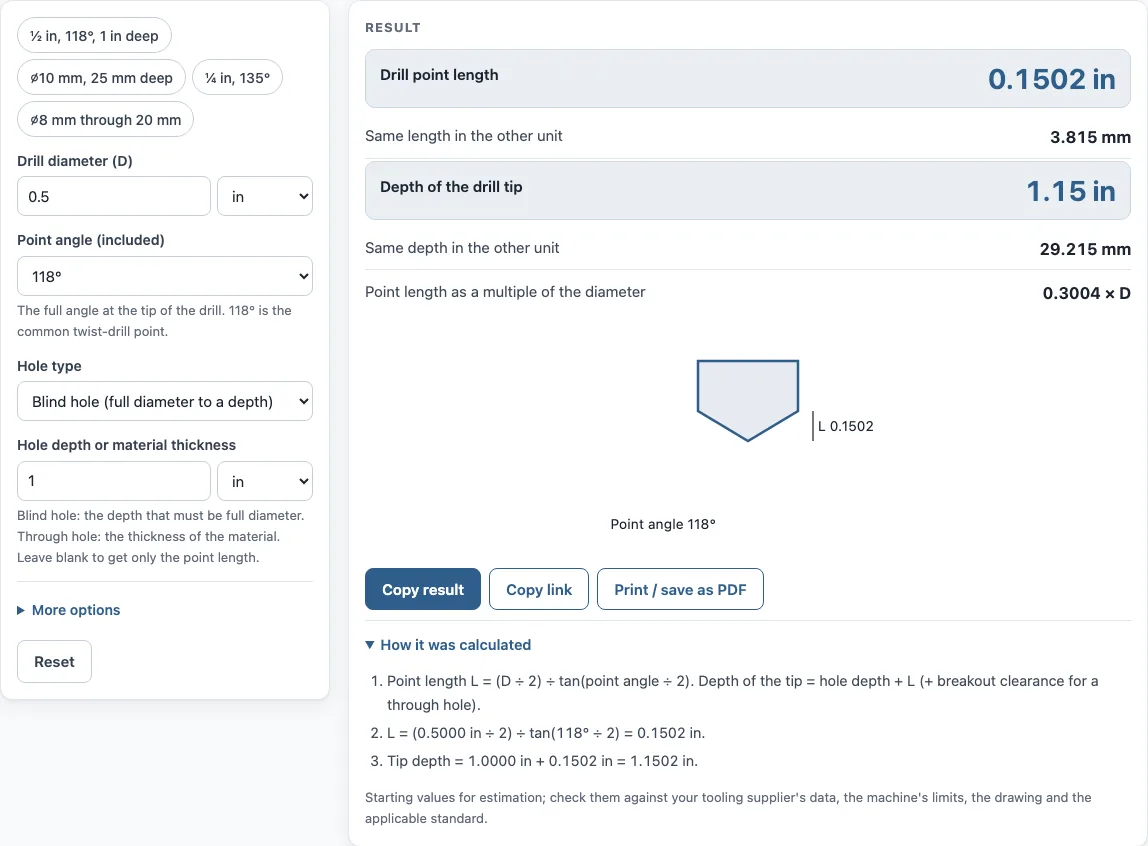
- Read the results: Drill point length, Depth of the drill tip, and the point length as a multiple of the diameter. The point length and the tip depth also appear in the other unit. The drawing shows the drill end and the point length.
- Open How it was calculated to see the formula and each step with your numbers.
You can start from a preset: ½ in at 118° and 1 in deep, ⌀10 mm and 25 mm deep, ¼ in at 135°, or ⌀8 mm through 20 mm. Copy result copies the result lines with a link. Copy link copies the page address, which stores every input, so opening it later restores the same calculation. Print / save as PDF prints the inputs, results, calculation steps and the date.
How do you calculate drill point length?
Divide the drill radius by the tangent of half the point angle: L = (D ÷ 2) ÷ tan(point angle ÷ 2). L is the height of the cone from the full-diameter shoulder to the tip.
For a 10 mm drill with a 118° point, the half angle is 59°. The tangent of 59° is about 1.6643, so L = 5 ÷ 1.6643 ≈ 3.004 mm. For a 90° point, tan(45°) is exactly 1, so L is simply D ÷ 2.
How long is a 118 degree drill point?
A 118° drill point is about 0.30 times the diameter long (L = 0.3004 D). A 10 mm drill therefore has a point about 3.004 mm long, and a ½ in drill has a point about 0.1502 in long.
118° is the most common twist-drill point angle. A 135° point is about 0.21 times the diameter, and a 90° point is exactly half the diameter.
How deep do you drill to get full diameter?
For a blind hole, the drill must reach the set depth H at full diameter, so the tip has to travel H + L. The tool shows this total as the depth of the drill tip.
For example, a ½ in drill with a 118° point, drilled 1 in deep, has a point length of 0.1502 in and a tip depth of 1.1502 in. A ¼ in drill with a 135° point, drilled 0.75 in deep, has a point length of 0.0518 in and a tip depth of 0.8018 in.
How much extra depth for a through hole?
For a through hole, the tip must pass through the bottom of the material, so the depth is the material thickness plus L. Add breakout clearance on top of that so the full diameter comes out cleanly through the bottom.
For an ⌀8 mm drill with a 118° point, drilled through 20 mm of material, the point length is 2.403 mm and the tip depth is 23.403 mm before any clearance. The breakout clearance is a value you choose for your setup. Enter it in the More options section.
Sources
- Point length L = (D ÷ 2) ÷ tan(angle ÷ 2) — plane trigonometry (height of a cone)
- Drill bit (Wikipedia) — 118° as the most common twist-drill point, 90° for very soft plastics, 150° for steels and tougher materials, and 118–135° (steel, stainless), 90–135° (aluminum) in the tool-geometry table
- 1 in = 25.4 mm exactly (NIST SP 811)
Worked examples
| Input | Result |
|---|---|
| ⌀0.5 in, 118° point, 1 in deep | Point length 0.1502 in, tip depth 1.1502 in |
| ⌀10 mm, 118° point, 25 mm deep | Point length 3.004 mm, tip depth 28.004 mm |
| ⌀0.25 in, 135° point, 0.75 in deep | Point length 0.0518 in, tip depth 0.8018 in |
| ⌀8 mm, 118° point, 20 mm deep | Point length 2.403 mm, tip depth 23.403 mm |
Calculated by the tool above with these values.
Frequently asked questions
Why does the tool warn when I choose an angle below 90°?
Angles below 90° make a very sharp point. The warning often means the half angle was typed by mistake, so check the full included angle from the drill maker’s data.
Which point angle should I pick for steel or aluminum?
Tool-geometry guidance lists 118° to 135° for mild and stainless steel, and 90° to 135° for aluminum. Use 150° for steels and tougher materials, and 90° for very soft plastics. Check the drill maker’s data for the exact angle of your drill.
Can I leave the hole depth blank?
Yes. If you leave the Hole depth or material thickness box empty, the calculator shows only the point length.
Can I use the results in customer documents?
Yes. Results may be used in commercial work, including quotes, shop travelers, setup sheets, inspection reports and customer documents, without attribution.
Is a drill tip calculator the same as a drill point calculator?
Yes. People use both names for the same calculation: the length of the cone at the end of the drill, found from the diameter and the point angle.
Does the calculator model a split point or a ground point?
No. It treats the point as a plain cone from the full-diameter shoulder to the tip. The tip of a split-point or specially ground drill can differ a little, so check the drill maker’s data if the last fraction of a millimetre matters.
Related tools
- Drill size chart: use it to find the decimal and metric size of a drill before you enter its diameter here.
- Drill and tap chart: use it to check the tap drill size that goes with a thread.
- Countersink depth calculator: use it when you need the depth of a countersink for a screw head.
- Chamfer calculator: use it to size a chamfer on the edge of a hole.
- Speeds and feeds calculator: use it to set spindle speed and feed rate for the drill.
- All machining calculators: use it to browse every calculator on the site.