Decimal to Fraction Inches Converter
Type a decimal, a fraction or millimetres to get the nearest fraction of an inch and how far off it is; the full chart is below.
The decimal to fraction inch converter turns a decimal inch measurement, such as 0.3125, into the nearest fraction of an inch, such as 5/16. It runs in your browser, is free, needs no sign-up, and works on a phone.
You can type a size as a decimal inch, a fraction, a mixed number such as 1 3/8, or millimetres such as 7.94mm. A bare number is read as inches. You choose how fine the answer should be, from 1/8 inch down to 1/128 inch, with 1/64 as the default.
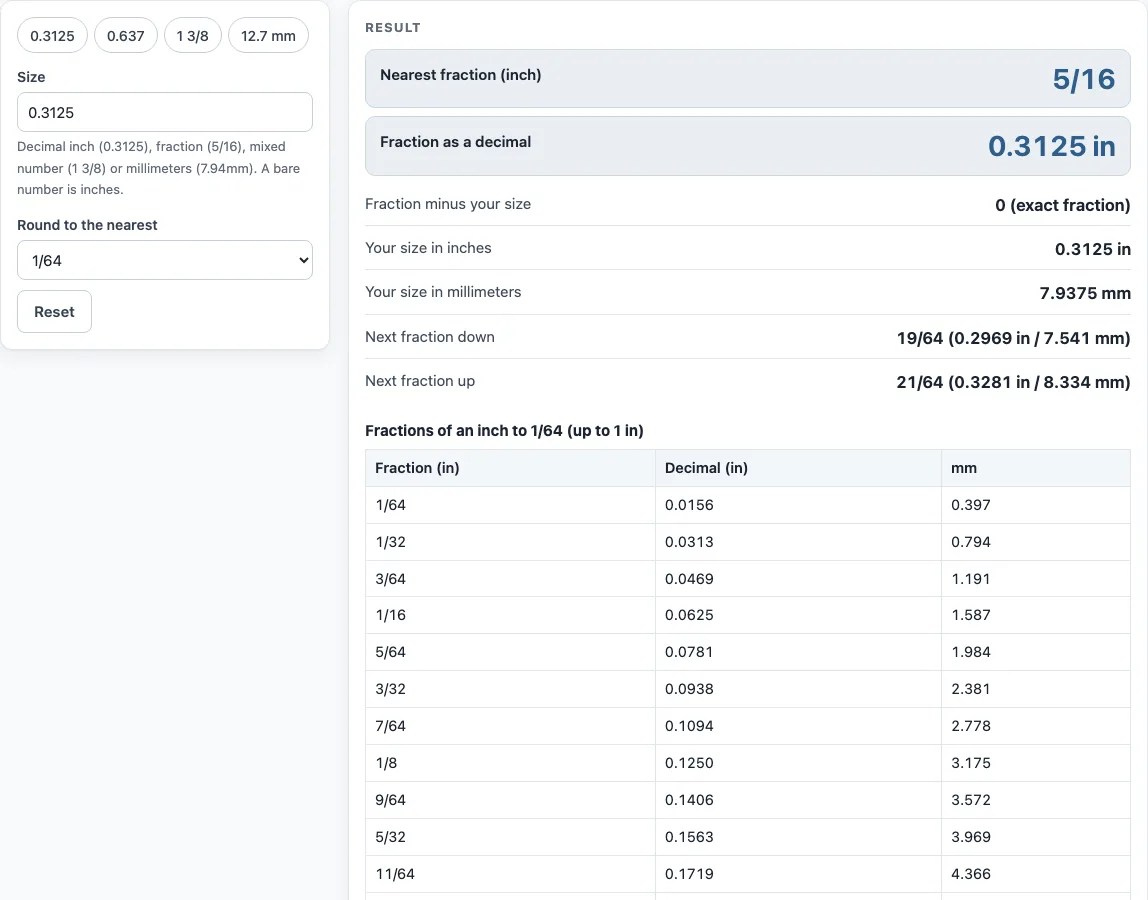
The result shows the nearest fraction in lowest terms, its decimal value, and the difference between that fraction and your size in inches and millimetres. It also lists the fraction just below and just above your size. Below the result is a chart of every fraction of an inch up to 1 inch at your chosen precision.
How to use the Decimal to Fraction Inch Converter
- Click the input box and type your size. Use a decimal inch like 0.637, a fraction like 5/16, a mixed number like 1 3/8, or millimetres like 7.94mm.
- Leave out any unit if you mean inches. A bare number is always read as inches.
- Choose the rounding precision: 1/8, 1/16, 1/32, 1/64 or 1/128 inch. It starts at 1/64.
- Read the result. The nearest fraction appears in lowest terms, with its decimal value.
- Check the difference line. It shows fraction minus your size, in inches and mm. A minus sign means the fraction is smaller than your size.
- If a warning appears, the nearest fraction is far from your value at this precision. Choose a finer option and check again.
- Scroll to the chart below the result to compare nearby sizes. Each row gives the decimal to 4 places and millimetres to 3 places.
- Open “How it was calculated” to see the formula and each step with your numbers.
Results update as you type. Copy result copies the result lines with a link. Copy link copies the page address, which stores every input, so opening it later restores the same calculation. Print / save as PDF prints the inputs, results, calculation steps and the date.
How do you convert a decimal to a fraction of an inch?
Multiply the decimal by the denominator you want, round the answer to a whole number, and use that number as the top of a fraction over the same denominator. Then reduce the fraction to lowest terms. For a 64th, the denominator is 64.
For 0.625, 0.625 × 64 = 40, so the value is 40/64. Dividing the top and bottom by 8 gives 5/8. Many decimals do not come out whole. For 0.637, 0.637 × 64 = 40.77, which rounds to 41, so the nearest 64th is 41/64, or 0.6406.
Rounding is where the error comes from. Rounding to the nearest 64th can be off by up to half of a 64th, which is about 0.0078 in. For a 128th, the same method applies with 128 as the denominator, and the error is smaller. Machinists usually work in thousandths (0.001 in) when a closer answer is needed.
How do you convert fractions of an inch to decimals?
Divide the top number by the bottom number. For 5/16, 5 ÷ 16 = 0.3125 in. For 3/8, 3 ÷ 8 = 0.375 in. A mixed number keeps its whole part and converts the fraction part the same way, so 1 3/8 = 1 + 0.375 = 1.375 in.
To change inches to millimetres, multiply by 25.4, because 1 inch equals exactly 25.4 mm. So 1/2 in × 25.4 = 12.7 mm. To change millimetres to inches, divide by 25.4. For example, 7.94 mm ÷ 25.4 = 0.3126 in, which is very close to 5/16 in.
How precise should the fraction be?
Pick the precision from the job. Tape measures and rulers are marked in 1/16 or 1/32 in, so round to those for layout. Drill and stock sizes run in 1/64 in, so use 1/64 when you look for a fractional drill. For machining tolerances, work in thousandths and use the fraction only as a name for the size: rounding to 1/64 in can be off by up to 0.0078 in, and to 1/128 in by up to 0.0039 in.
Sources
- Nearest fraction = round(value × denominator) ÷ denominator, reduced
- 1 in = 25.4 mm exactly (NIST SP 811)
Worked examples
| Input | Result |
|---|---|
| 0.3125, nearest 1/64 | 5/16 in = 0.3125 in, difference 0 (exact fraction) |
| 0.637, nearest 1/64 | 41/64 in = 0.64063 in, difference +0.00362 in (+0.0921 mm) |
| 1 3/8, nearest 1/64 | 1-3/8 in = 1.375 in, difference 0 (exact fraction) |
| 12.7mm, nearest 1/32 | 1/2 in = 0.5 in, difference 0 (exact fraction) |
| 0.4, nearest 1/16 | 3/8 in = 0.375 in, difference −0.02500 in (−0.6350 mm) |
Calculated by the tool above with these values.
Frequently asked questions
Why does the result show a difference?
The difference is the nearest fraction minus your size, in inches and millimetres. It is 0 when your size is an exact fraction at the chosen precision; otherwise choose a finer fraction, such as 1/128, if the difference is too large for the job.
What is 0.625 as a fraction of an inch?
It is 5/8 of an inch. Multiplying 0.625 by 64 gives 40, and 40/64 reduces to 5/8. At 1/64 precision the tool shows 5/8 in with a difference of 0, because the fraction is exact.
What is 1/64 inch as a decimal?
1/64 inch is 0.015625 in, or 0.397 mm. It is the step between neighbouring rows of the chart at 1/64 precision.
How many mm is 1/16 inch?
1/16 inch is 1.5875 mm. Divide 1 by 16 to get 0.0625 in, then multiply by 25.4.
What is 0.3125 in a fraction?
It is 5/16 of an inch. Multiplying 0.3125 by 16 gives exactly 5, so the fraction is 5/16. The difference shown by the tool is 0.
Can I print the fraction to decimal chart?
Yes, use Print / save as PDF. It prints the inputs, results, calculation steps and the date. Set the precision to the fractions you need before printing, because the chart is built at the precision you choose.
How many decimal places does the chart show?
Decimals are shown to 4 places and millimetres to 3 places. The result above the chart shows your own size and the difference to the nearest fraction.
Related tools
- Drill size chart: use it when you need to match a hole size to a drill bit size.
- Drill and tap chart: use it to look up drill and tap sizes together.
- Thread pitch calculator: use it when you need to work out thread pitch for a fastener.
- Bolt circle calculator: use it to place holes evenly on a circular pattern.
- Chamfer calculator: use it to work out chamfer dimensions on an edge.
- Tenths to inches calculator: Use it to convert tenths, thou and mm to decimal inches.
- All machining calculators: use it to browse every calculator on the site.